
Clean Hands
Greece, the CIA, and the 1967 Coup

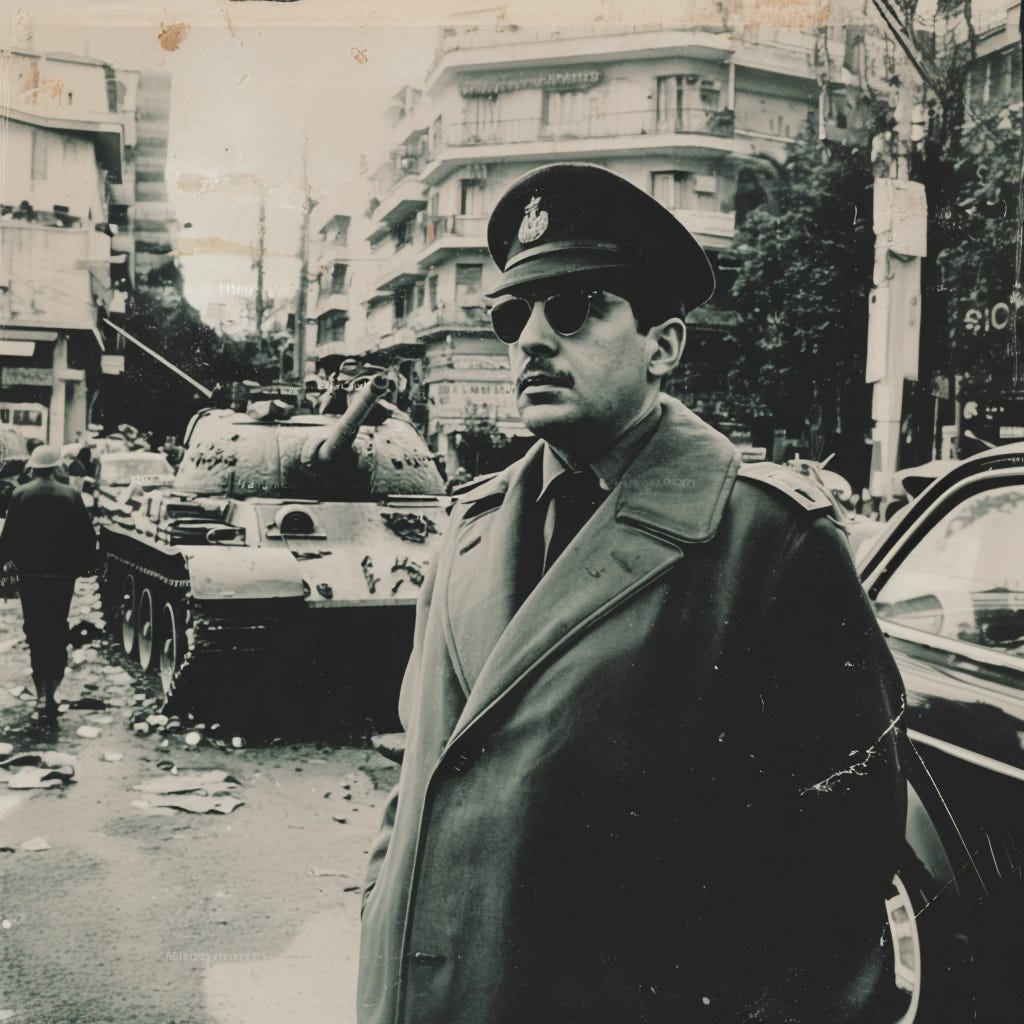
Colonel Ioannis Ladas, Secretary-General of Greece’s Ministry of Public Order, summoned Panayiotis Lambrias, editor of the magazine Eikones, into his office on July 29, 1968. Ladas wanted to discuss the publication of an article noting that homosexuality had been regarded as normal in ancient Greece. As Lambrias entered, Ladas addressed him without looking up from the papers on his desk, sneering: “So you too are working in this anal periodical?” The insult stunned Lambrias into silence. He had no time to respond; Ladas suddenly rose from his desk and struck him “with his fist between my nose and my eye,” Lambrias recalled, then launched into what he described as “the insults of the lowest guttersnipe.” Between blows, the Greek government official shouted threats and abuse: “You are a pansy, a Bulgar. You shall die. I shall kill you with my own hands.” The attack escalated into a frenzy. “You have excrement in your very soul. You sell Greece for money,” Ladas roared, before turning to Lambrias’ family: “Your daughters are prostitutes.” Lambrias had two daughters, aged eight and ten at the time.
The beating continued with what Lambrias called “unheard-of mania.” He estimated that he was struck “ten to twelve times,” all while remaining upright and unable to speak. Throughout the assault, Ladas fixated on accusations of national betrayal, repeatedly branding him a Bulgarian and declaring that he had no place in Greece. “You must leave Greece. Go and join your friend Helen (Vlachos), that arch-prostitute,” he bellowed, referencing the Greek publishing heiress who had closed her newspaper in protest of the dictatorship. “If you don’t clear out I’ll kill you with my own hands.”
Even then, the humiliation was not over. Still striking him, Ladas summoned two subordinates and ordered, “Take him away along with the others and let him die. Don’t bring him out unless I tell you to.” For the new regime in Greece, this was not an isolated act. This was not the coup the powerful had planned.
Deane
I am not going to scream. I am not going to scream. I am not. I am not. Philip Deane was tied to a chair, being kept awake by his captors in North Korea in 1950. He could smell the breath of the man screaming before him, recoiling at “the stench of fermented soya bean paste.” The screaming was unending, a repetitious mantra meant to break his spirit: “You will never get out of here if you do not co-operate. You will never get out of here. Your wife will sleep with men. She will find one she will like better than you. You will never get out of here. Your wife will find one man she will like better than you. You will never get…”
Deane was captured in July 1950, only days after arriving in Korea as a war correspondent. He was wounded during a North Korean advance, taken prisoner, and marched barefoot to North Korea. Brought to a stark interrogation room, Deane was subjected to harsh treatment from a Russian officer he nicknamed Lavrenti, followed by two Koreans, Kim and Pak, who sought to force him to confess that he was an American spy. They demanded he make radio broadcasts accusing the United States of bombing civilians and argued that his journalistic work, including exposing sensitive information and infiltrating Albania, proved he was engaged in espionage rather than reporting. Deane refused to assist them, believing that any concession would strip him of control and endanger others.
The interrogations relied on relentless repetition, philosophical argument, sleep deprivation, intimidation, and psychological degradation. He was threatened with execution, told that his death would go unnoticed, and warned that his wife would forget him. His worsening gunshot wounds were used as leverage, with interrogators implying he would be denied medical care because spies were executed, not treated.
During an air raid, locked alone in the room and determined not to display fear, Deane cauterized his own infected wounds by burning twigs. Under sustained interrogation and physical abuse, he experienced a profound psychological split, separating into two selves. While his body remained strapped to a chair, absorbing pain and humiliation, his mind retreated into vivid childhood memories, particularly of his father and uncle, men who he believed embodied courage and defiance under repression in Greece. Deane would not be released from North Korean custody until April 9, 1953, only a few months before the end of the Korean War.
Washington
“Watch how she jiggles as she struts,” Senator Lyndon Johnson directed Deane as they sat in a U.S. Senate office, leering at his secretary, “a spectacular blonde,” in Deane’s words. Johnson continued: “You don’t see such high spirited strutting nor jiggling every day.” After she had walked several steps on the carpet in one direction, Johnson demanded that she turn around and walk back. He enjoined Deane in a voice loud enough that she could hear him: “Now watch the back view and refresh yourself before we get down to business.”
Born in Greece, Deane’s real name was Gerassimos Gigantes; the London Observer had given him the pen name Philip Deane. After his imprisonment in Korea, the moniker had “exposure and commercial value. So Philip Deane I remained.” He was granted an interview with LBJ in the late 1950s, which he found “depressing.” He criticized Johnson’s “comic strip vision of the world, with American supermen fighting Communist evil everywhere, while lesser nations, like Greece, expressed their gratitude for U.S. generosity.” Johnson was adamant that other nations had much for which to be thankful, given the United States’ interest in their affairs.
When LBJ became President, Deane joined the Greek government as a Secretary General to the King. Deane reported on Johnson’s interaction with Alecos Matsas, the Greek Ambassador to the U.S. who had been summoned to the White House to discuss an ongoing dispute regarding the island of Cyprus. A U.S. plan was being floated that would have given possession to Cyprus to Greece, with some self-governing Turkish areas and a Turkish military base on the island, in exchange for Greece giving Turkey the island of Castellorizo. “As Prime Minister [Georgios] Papandreou told you,” Matsas countered, “no Greek Parliament could accept such a plan. At any rate, the Greek constitution does not allow a Greek government to give away a Greek island.” LBJ was incensed: “Then listen to me, Mr. Ambassador. Fuck your Parliament and your Constitution. America is an elephant. Cyprus is a flea. Greece is a flea. If those two fleas continue itching the elephant, they may just get whacked by the elephant’s trunk, whacked good.”
Matsas emphasized that “Greece is a democracy; the Prime Minister cannot act against the wishes of Parliament.” Johnson had no use for this rationale: “We pay a lot of good American dollars to the Greeks, Mr. Ambassador. If your Prime Minister gives me talk about democracy, parliament, and constitutions, he, his parliament and his constitution may not last very long.” A memo summarizing a meeting between LBJ and Matsas on June 11, 1964 quoted Johnson as urging the Greeks and Turks to make proposals to one another: “Get together and work something out. If not, all NATO will become involved.” A CIA paper from August 1964 opined on the overall value of the proposed island transfer: “An offer of Castellorizo to Turkey by Greece could not be considered very generous. The island is generally barren, has no significant agriculture or industry, and supports a dwindling population.”
Deane learned more about the U.S. administration’s views of his government through U.S. reporter Marguerite Higgins. Johnson’s view was that the Greek Prime Minister Papandreou had “betrayed America.” When Higgins asked LBJ to explain, he ranted: “We gave the son of a bitch American citizenship, didn’t we? He was an American, with all the rights and privileges. And he had sworn allegiance to the flag. And then he gave up his American citizenship. He went back to just being a Greek. You can’t trust a man who breaks his oath of allegiance to the flag of these United States.”
Papandreou’s son Andreas, elected to the Greek Parliament in 1964, was rising through the ranks quickly. Deane brought his concerns about U.S. perspectives to Attorney General Robert F. Kennedy: “All kinds of unsubstantiated information is reaching Washington,” Deane stated. “Greeks like Andreas Papandreou are being represented as Communists by your people in Greece. The U.S. might be badly misled by wrong information coming from Greece.” Kennedy replied: “There’s nothing I can do about it. Lyndon won’t listen to me.”
The King’s Coup
While working for the King, Constantine II of Greece, Deane became aware early on of a plot to overthrow the government. General Konstantinos Dovas, head of the military household for the King, confided hints of what was in the works: “If we must have a Parliament, and I suppose we must, let us reduce its capacity for mischief. We should have something like the American system; only ours would be better because we would not have to elect a president.” Deane learned that under this proposal, the King would possess powers similar to the U.S. president, except he would be unelected. Parliament, in Dovas’ words, “would approve or disapprove the legislation proposed by the King’s ministers. There should be limits, of course, to how much disapproving our indescribable representatives of the rabble could do.” Deane went to the King himself with this information and found that he was in favor of the idea, Deane later writing: “The fact that he would not be elected but would be chief executive by divine right and heredity, did not seem to strike His Majesty as odd.”
Deane took up the matter again with Dovas: “I don’t believe in coups,” Deane stated. “I hope measures have been taken to make sure no coup takes place.” Dovas smiled: “We’ve taken measures. We have seen to it that loyal officers hold key positions.” Given his role, Deane was able to piece together a list of coup plotters by pretending to need their names for other reasons: “That officer who entered General Dovas’ office,” he would say, “my father showed him to me once and told me he was remarkable, I’ve forgotten his name…” He assembled his list, which included figures such as Georgios Papadopoulos, Ioannis Ladas, and five other senior participants. Deane asked his father, who had previously worked in Greek intelligence, to weigh in: “These names you gave me, of the officers who are visiting the palace, they are all part of a plot. There will be a coup. The leaders will be generals. The junior ones…are doing the dirty work. They will strike one night and overthrow the government.” Deane’s father explained that his sources were former associates from the KYP, the Greek CIA: “I got drunk and gave my anti-Papandreou speech. By the small hours, we were all drunk and many of them talked. The coup is no longer a contingency plan. It is a reality. Only the date has not been fixed.”
Deane checked out the rumor at the U.S. Embassy, where he encountered the CIA Chief of Station John M. “Jack” Maury. The CIA Chief openly boasted of his power and staff: “I have 60 full-time members of my staff which makes me more important than the ambassador, I guess, as anyone can see: my official car is bigger and more expensive than his,” he laughed. He called Papandreou “‘a real chameleon: a Trotskyist, then an American citizen who actually served in our Navy, and now he gives up American citizenship and becomes an anti-American.” When Deane probed whether Greece had any hope of good governance through its politicians, a U.S. colonel in the conversation responded: “Not by your politicians, but there are other men.” The colonel pointedly made an endorsement: “Remember Colonel Papadopoulos, then. He will govern you well.”
Deane again called his father, who explained how Andreas Papandreou was courting disaster by quoting the U.S. declaration of independence and making it “sound subversive.” Deane chastised him: “Be serious father.” His father was upset at the accusation: “I am being serious, goddammit. To the Americans we are a base they have bought. They want no headaches, no lectures, no interviews to U.S. journalists who then criticize the American government for not supporting democracy in the cradle of democracy. The Americans are businessmen. They have had a right wing caretaker in this property of theirs and were prepared to try a Liberal caretaker, but they will keep the Liberal only so long as he acts submissively like the old one.” Deane was surprised at his father’s view: “You make us sound like a colony.” His father was nonplussed: “What did you think we were?”
On March 8, 1967, a meeting in Washington, DC of the 303 Committee, a group tasked with overseeing the CIA, was convened. The White House committee was given an intentionally “drab and innocuous” name to not draw attention to its purpose. Topic number 4 on the agenda was Greece; U.S. National Security Advisor Walt Rostow had reservations on conducting covert political action in the upcoming Greek elections but wanted to hear the arguments. The committee heard that “U.S. participation could not guarantee the winner it certainly would have an impact…Andreas Papandreou had been observed for a sufficient period to realistically place him in a camp definitely hostile to U.S. interests.” Papandreou as a candidate was deemed to be difficult to stop, since he was “driving very hard while other candidates were, at best, lethargic.”
Rostow wanted to know if the approach to interfering in the election was following “momentum started in the fifties.” The U.S. had “assets, techniques and money” in place in Greek and “could perform almost by rote.” He wondered if the threat was “that great?” Foy D. Kohler, the former U.S. Ambassador to the Soviet Union, thought that the papers prepared “had not made the election issues entirely clear” and asked if they were “attributing more potential to Andreas than he deserved.” Rostow was then called away to another meeting and they agreed to finish the discussion on March 13. On March 9, the CIA sent a cable with the subject line “Increased Activity of Group Advocating Dictatorship,” outlining the pending plans for a coup in Greece. According to their source, Lieutenant General Grigorios Spandidakis, the plan for “the military take-over of Greece [is] contingent upon the occurrence of another political crisis. In the event such a crisis occurs, the plan outlines the role of key military units which would be involved in the take-over.” The units were in a “fairly high state of readiness,” Spandidakis reported.
The 303 Committee reconvened on March 13 to conclude the discussion on potential covert action involving the Greek elections. The CIA noted Papandreou’s appeal to “discontented youth”; Rostow countered that “there were other examples of leftists settling down after an election,” citing Rómulo Betancourt, the former President of Venezuela, as an example. The CIA believed that Papandreou represented a “distinct threat” due to “his percolating animosity to the United States which was unlikely to change,” adding that as Papandreou moved “closer to victory,” the potential increased that the monarchy and military would “suspend the constitution and take over.” Divided over how to proceed, they decided to take the matter up with Secretary of State Dean Rusk, who was reported the next day as coming down “negative. In the Greek case, he believes the possible political gain is outweighed by the security risks.” Rusk revealed that there was a group of “dual-national Greek-Americans” seeking the government’s overthrow and stated that if they needed the CIA’s $200,000-$300,000 ($1.9-$2.9 million today) to sway the election, “they should have no trouble raising that sum themselves without involving the United States Government.”
Stones
As part of their 1967 concert tour, the Rolling Stones played in Athens on April 17, 1967. Playing to 10,000 young Greeks at Panathinaikos Stadium, the band sparked excitement as the first major rock act to perform in Greece. A heavy police presence overshadowed the performance, which was cut short. When Mick Jagger attempted have the band’s fixer Tom Keylock throw carnations into the crowd, police responded with water cannons, prompting the band to abandon the stage and flee. Officers stormed the stage, the show was halted, and clashes erupted as police attacked the crowd and made arrests. U.S. Foreign Service Officer Robert V. Keeley was in attendance with his wife and teenager daughter. As he watched the police “viciously beat the kids with sticks,” a journalist friend commented to them, “They’re practicing for the coup. That’s the way it will be when it comes.”
By this point, Keeley had became convinced that Greece was on the brink of a military-backed dictatorship and that such an outcome would be disastrous for U.S. interests. With the elections 38 days away, Keeley sat down to draft a detailed memorandum warning the Embassy of the danger and urging immediate action. Keeley argued that a coup was increasingly likely because powerful forces, including the Palace, conservative political elites, and the military, were determined to prevent a likely electoral victory by Papandreou. He reasoned that postponing elections, engaging in massive fraud, or provoking unrest would all lead inexorably to dictatorship, most likely imposed before the elections rather than after them. He stressed that timing was critical: the decisive window was the weeks leading up to the vote, and the coup-makers would probably act without warning to present the United States with a fait accompli.
Keeley warned that, regardless of U.S. intentions, most Greeks would hold Washington responsible for any dictatorship, believing the United States either condoned or engineered it. Keeley urged clear, unequivocal U.S. opposition in advance, arguing that American leverage, through NATO, military aid, and security guarantees, gave Washington a real chance to deter a coup. Ambiguous signals, he cautioned, could encourage the King or military leaders to miscalculate disastrously.
In assessing consequences, Keeley rejected the idea that dictatorship would stabilize Greece or contain communism. Drawing lessons from the Metaxas regime that ruled the Kingdom of Greece from 1936 to 1941, he argued that repression would likely strengthen the left underground, alienate the political center, and ultimately produce a far broader resistance movement, potentially leaving Greece vulnerable to communist dominance once the dictatorship collapsed. He believed this outcome could be even more dangerous than tolerating an Andreas Papandreou government, whose reformist agenda he saw as partly necessary and whose foreign-policy independence he viewed as comparable to trends elsewhere in Europe. “The only way out of this dilemma that I can see,” he wrote, “is that we must at all cost prevent the establishment of a dictatorship.”
In retrospect, Keeley noted that he correctly foresaw a coup but misidentified its form. He finished the memo on the evening of April 20 and stored it in a safe at the U.S. Embassy, intending to have a secretary type it up the next morning, unaware of how imminent the crisis truly was.
The Colonels’ Coup
“Oh my God!” Keeley exclaimed the next morning when he learned of the takeover from his son, who reported that schools and buses were shut down and tanks were moving toward Athens. Driving to the U.S. Embassy, Keeley was stopped at a major roadblock where Greek soldiers barred all civilian diplomats, even ambassadors, while allowing foreign military officers to pass, an arrangement that struck him as politically telling. As one of the few diplomats who spoke Greek, Keeley took a leading role in arguing with the captain in charge and organizing fellow diplomats to press their case. The confrontation grew tense: “At one point,” Keeley remembered, “the soldiers pushed us back from the intersection toward the nearest apartment building, and a few colleagues decided they should perhaps go home and wait things out after they observed some bloodstains on the sidewalk nearby.” Among those turned back was CIA station chief Jack Maury, who later returned wearing his old Marine colonel’s uniform and successfully passed through the checkpoint. Eventually, the captain temporarily lifted the restriction, allowing the diplomats through.
Once the diplomats made their way to the office, the U.S. Embassy in Greece that day reported to Washington that a military coup had taken place, led by a “small army group” which did not include “High Command, [the] King or civilian political leaders.” Andreas Papandreou was reported to have been arrested and taken to a “local military prison.” That evening, U.S. Ambassador Phillips Talbot revealed that King Constantine was “blazingly angry” that he and his Generals were no longer in control of Greece; his planned coup had been usurped by another coup. He now bitterly complained that “incredibly stupid ultra-right-wing bastards, having gained control of tanks, have brought disaster to Greece.” He considered “shooting [the] perpetrators” when they arrived at the Palace but thought this would be “worthless” given that the Palace was “surrounded by tanks loyal to them.” It was “important to hold [the] King’s comments closely at this time,” Talbot noted. The State Department expressed that the U.S. government was “deeply distressed” at “the use of American-furnished equipment to overthrow the constitutional government of Greece.”
In contrast to Deane’s experience with the CIA Station Chief, Keeley portrayed Maury as a polished, old-school Virginia gentleman who possessed a courteous, easygoing manner. A former Marine colonel, he avoided discussing his postwar career but had spent several years in Greece running a large CIA operation with apparent ease and firm control. Although he occasionally entertained colleagues with hints of covert intrigues, he seemed to reserve his most sensitive knowledge for trusted confidants. “There were rumors that he had a mistress: no one cared,” Keeley recalled. “If he didn’t have one, he should have. It went with his role.”
The leader of the coup, Georgios Papadopoulos, had been a CIA agent for many years, and acted as liaison to the CIA from the KYP, the Greek intelligence agency. “These colonels had been plotting for years and years,” Keeley explained. “They were fascists. They fitted the classic definition of fascism, as represented by Mussolini in the 1920s: a corporate state, uniting industry and unions, no parliament, trains running on time, heavy discipline and censorship…almost a classic fascist ideal.” Despite the ties between Papadopoulos and the CIA, the coup took the Agency by surprise. As CIA officer Richard Lehman recalled: “The only time I saw [CIA Director Richard] Helms really angry was when the Greek colonels’ coup took place in 1967. The Greek generals had been planning a coup against the elected government, a plan we knew all about and was not yet ripe. But a group of colonels had trumped their ace and acted without warning. Helms had been expecting to be warned of the generals’ coup, and when a coup occurred, he naturally assumed it was this one, and he was furious.”
The U.S. Embassy urgently sought biographic and political information on the officers who had seized power in order to assess the new regime’s orientation. Washington pressed for insight into whether the coup leaders were aligned with familiar, pro-American senior generals or represented a more opaque faction. However, U.S. military attachés and JUSMAGG proved largely unhelpful: their files focused on career details and personal trivia, avoided political assessments, and reflected an ingrained belief, despite historical evidence, that the Greek army was apolitical. Moreover, few coup leaders had received U.S. training, suggesting they were mid-level, less distinguished officers, often lacking English proficiency.
In desperation, Embassy officials turned to the CIA station, at which “the number two CIA officer proudly showed us a report from January 1967” identifying a conspiratorial group led by Colonel Papadopoulos. Crucially, there were no subsequent CIA reports on this group after January, even though coup rumors were rife in Athens. Instead, intelligence attention had shifted almost entirely to a different, senior-officer plot associated with General Spandidakis.
Later inquiries at the State Department’s Intelligence and Research confirmed this gap. Analyst Charilaos Lagoudakis recalled extensive CIA reporting on the Papadopoulos group between 1965 and January 1967, including warnings that it was prepared to stage a right-wing coup and would seek U.S. support afterward. Lagoudakis had explicitly requested further intelligence in February 1967, but none arrived before the coup. Keeley speculated that either the conspirators severed their intelligence links once they moved into operational mode, or that later intelligence existed but was withheld or not disseminated, leaving U.S. officials strikingly unprepared for the April 21 takeover.
Breakdown
In the immediate aftermath of the April 21 coup, Greek employees of the U.S. Embassy were sent home, and although the Embassy was officially closed the following Saturday, work continued amid intense pressure. The Political Section resumed its routine with a briefing by Aleko Tzinieris, their press analyst, who noted the strict censorship now imposed: Union of the Democratic Left newspapers were shut down, conservative publisher Helen Vlachos halted her papers rather than submit to censorship, and Eleftheria ceased publication after its editor, Panos Kokkas, fled the country during the coup. Then Tzinieris did something completely out of character that they did not expect.
