
Invisible Battles
Coups, Cash, and Consequences

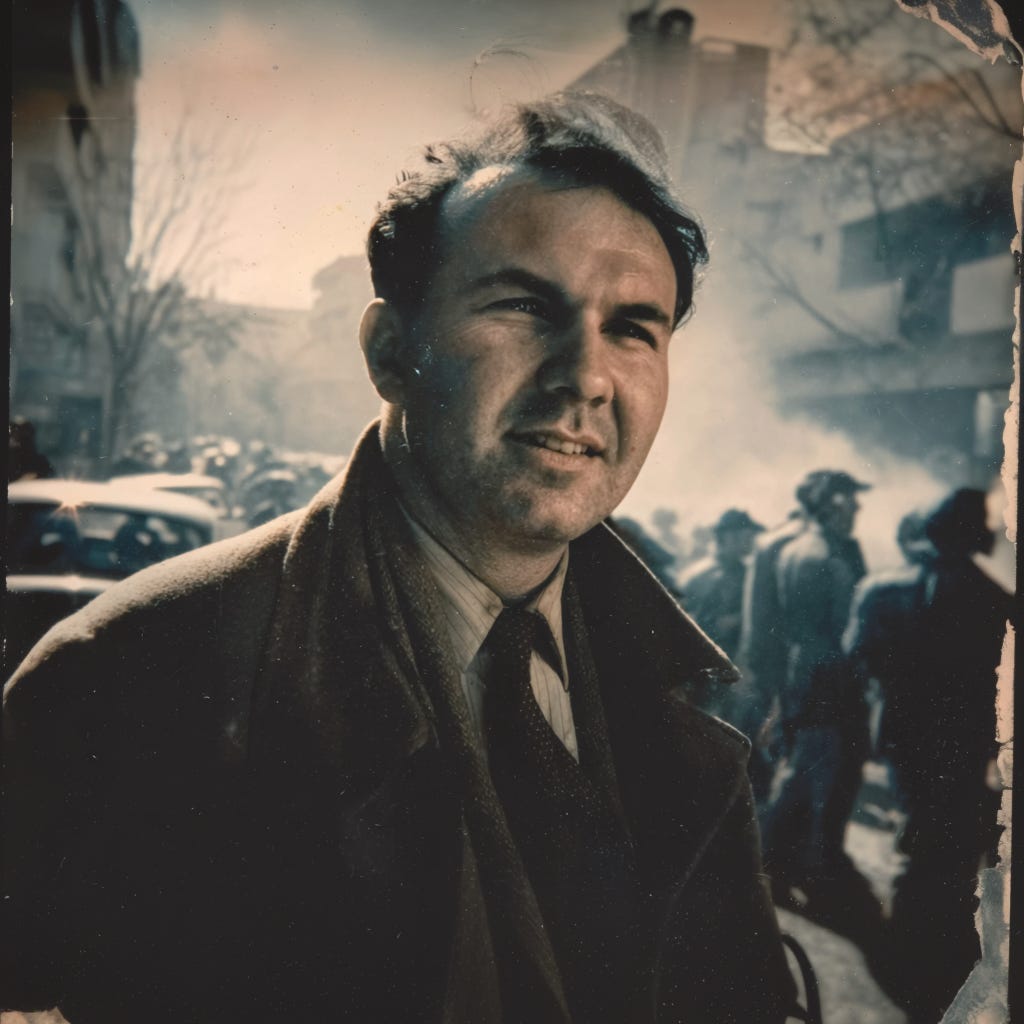
When Howard “Rocky” Stone ran into Alice Marie Mueller at CIA headquarters in 1950, then located in Washington, DC, they were both working for the little-known Agency. “What’s the CIA?” had been Mueller’s reaction when first told of the job opportunity by a friend. At her CIA interview, she typed slowly, around 20 words a minute, and thought she had failed the test. “Your typing won’t set the world on fire, but that’s not what we’re hiring you to do,” her interviewer admitted. Known by the nickname “Ahme,” stemming from her brother’s struggle to pronounce her name as a toddler, Mueller was placed on the Czechoslovakia desk at the CIA on the intelligence side of the Agency, while Rocky worked on covert operations. Stone remembered her; she had brought a dog to class when she was a student at the University of Southern California and he was a teaching assistant. She remembered him for having given her a bad grade in the class. They were soon married in August 1951 and thrust into the world of espionage. Within a year, they were working to overthrow a foreign government.
As a junior officer, Stone and his new bride were assigned to Tehran, Iran. Ahme recalled the assignment: “During this time, Rocky helped orchestrate the coup that restored Mohammad Reza Pahlavi to the Iranian throne.” Stone remembered safeguarding General Fazlollah Zahedi, the CIA-backed figure in the Iranian military who had just been appointed Prime Minister by the Shah. The CIA’s leader of the project known as TPAJAX, Kermit “Kim” Roosevelt, visited Stone’s safehouse to inform Zahedi that he needed to be ready to announce himself as the new Prime Minister of Iran. The general was so anxious that he was unable to dress himself and Stone helped him button his military jacket. Around two hundred Iranians died on the street that day. Meanwhile, Ahme, his young wife, sat composed in a rocking chair at their home, concealing a handgun beneath her knitting as she kept watch over Ardeshir Zahedi, the general’s 25-year-old son and a CIA asset. In the years that followed, Ardeshir would go on to serve as the Shah’s Ambassador to the United States. Prime Minister Zahedi in the immediate aftermath of the 1953 coup became “a friend of U.S. oil interests,” according to an article in the School of Advanced International Studies of Johns Hopkins University in 1982, “and under his leadership the British monopoly disappeared for all time.”
Sudan
In September 1955, Stone joined the CIA office in Khartoum, Sudan as Station Chief, arriving with his family in tow, including three children under the age of three. He put Ahme to work, having her ride a donkey to the Station to deliver his coded messages. His main task was to recruit agents, who were frequently of questionable character, to provide sensitive information to the Agency. Often this was accomplished through bribes or blackmail, but Stone preferred another approach. Believing he had the ability to “recruit a lamppost” if the occasion called for it, Stone wanted to go after senior government officials known to have good moral character, thinking they would be more reliable. He decided to put this to the test in the attempted recruitment of a high-level government official in a key ministry in Sudan. He spent months staking out his candidate to learn “what this man really wanted out of life.” Included in the man’s profile were what Stone thought were his main characteristics: he was unattractive, had a controlling wife, and took great pride in his child, but he had difficulty paying for the child’s boarding-school tuition.
Stone first targeted the man’s marriage to gain his cooperation. When he would meet with the official and witnessed the wife’s abuse, Stone worked to “put her in her place” and told her that she did not have the right to treat her husband in this fashion. “He loved that,” Stone remembered. “I was doing something that he couldn’t do.” The wife in turn was “amazed that someone in my position would care about a schnook like that.” Next, Stone worked on fixing the funding issue for his child’s schooling, using CIA money to partly pay for the boarding school. The influence operation began to yield results, with the official revealing small pieces of information, until the man one day became a full-blown agent. “When the gate finally opened, it was a flood,” Stone recalled. The official ultimately provided thousands of documents that the CIA found useful over several years; the man died and was never revealed to have been a source for U.S. intelligence. Stone described the process of turning him into an agent as follows: “What I did was take this man apart psychologically and put him back together. My rationalization for meddling in his life was that the man was better off the way we put him back together.”
Sudan received little attention from the United States until the lead-up to independence in 1956, when geopolitical concerns, especially access to the Suez Canal, renewed American interest. U.S. officials pushed strongly for North–South unity, with Ambassador Jefferson Caffrey insisting it be achieved “even at the price of selling the Sudan.” British officials expressed frustration at what they saw as American disregard for the entire country, with one U.S. diplomat using a racial slur in front of the British to dismiss the need to be concerned with the population of 10 million people. During the Cold War, Sudan’s importance grew due to fears of Soviet and Libyan influence, but U.S. understanding of the region remained shallow. After Stone’s departure from the country, the CIA found a distinct lack of local assets and a detailed handbook the Agency prepared for guerrilla warfare exposed their limited knowledge, offering simplistic warnings about dangerous lions, crocodiles (“particularly bad along the Nile”) and witchdoctors (“a thriving business in charms”).
Syria
In 1954, the U.S. State Department in a briefing paper outlined Syria’s unacceptable neutralism: “Of all the Arab states, Syria is at the present time the most wholeheartedly devoted to a neutralist policy with strong anti-Western overtones. This appears to be due primarily to three factors: (1) the Syrians unlike the other Arabs feel themselves free of need to look to the West for any kind of support or help (they are economically self-sufficient); (2) bitterness over Palestine, and spite against the Western powers whom they regard as the creators and supporters of Israel; (3) the tendency in the Islamic world to seek a neutral position (with an anti-’imperialist’ flavor) between West and East. These factors find expression in popular neutralism and anti-Westernism; and such acts as the election of a Communist deputy to Parliament more as an assertion of anti-Westernism with pro-Soviet overtones than as an expression of actual Communist sentiment.” CIA Director Allen Dulles called it an “unhappy situation.”
Arriving in Damascus in April 1957, Stone was brought in to lead the final stages of a plan to install a pro-Western government in Syria, with an earlier coup having failed the previous year. The project, codenamed WAKEFUL, had been underway for two years with positive reports sent from the field to headquarters, which led HQ to believe that “all Rocky needs to do is light a match,” Stone remembered. Ahme, expecting their fourth child, remained behind with the children in Beirut, Lebanon, until suitable accommodations were prepared. During this time, she resided in an apartment above Harold “Kim” Philby, a senior and infamous figure within British intelligence who was secretly acting as a double agent. At that point, Philby was collaborating with the Soviet Union and nearing the final phase of his flight from British authorities, preparing to defect.
The new plan to overthrow the Syrian government involved delivering huge cash bribes to a small number of Syrian leaders. Unlike in Iran, Stone was unable to find any takers capable of undertaking a coup. “It is my duty to inform you that there is no WAKEFUL to trigger,” he wrote to Dulles. He looked for other conspirators to take on the assignment and he shifted his attention to identifying possible collaborators among the Syrian army’s junior officers. His search brought him to a charming tank commander, Captain Abdullah Atiyyah. As Atiyyah later recounted, the two met late one evening in early August at the apartment of a female U.S. Embassy official. Stone was there with his deputy, Francis Jeton, and over several hours Stone carefully laid a rationale as to why the young officer needed to resist communism taking over his country. He then provided details on the plan for the coup, which called for tanks to secure the city of Qatana while key positions in Damascus would be seized. Before agreeing to cooperate, Atiyyah insisted on meeting with the other Syrian leaders involved. The discussion concluded at six the next morning with both sides agreeing that an “ample” amount of cash would be placed in the glove compartment of an unlocked car parked nearby, to be retrieved by one of Atiyyah’s associates.
Responsibility for organizing the requested meeting fell to another CIA officer stationed in Damascus, Arthur C. Close. He was a young Arabist of missionary background who maintained close relationships with the former President Adib Shishakli and his ex–Intelligence Chief, Colonel Ibrahim al-Husseini, then serving as Military Attaché in Rome. CIA contractor Wilbur “Bill” Eveland later described a plan to smuggle Husseini, a giant “moose of a man,” from Beirut into Damascus hidden in Close’s car trunk. At the same time, Atiyyah was instructed to wait at a café at a particular time for a signal: Stone’s wife, Ahme, arrived in a car with diplomatic plates, stepped out, and began writing in a notebook. The scheme nearly collapsed when a child alerted a policeman standing close by that “this lady might be a spy trying to draw something.” Ahme managed to avoid being detained and the rendezvous ultimately proceeded in a shuttered room at another CIA safehouse. Inside, Atiyyah met with Husseini, who was disguised with a false beard and mustache. Having previously worked together, they quickly recognized each other and the young officer pledged his loyalty to the coup’s leadership. After swearing secrecy on a copy of the Koran he carried, Husseini described his rationale for joining the U.S. effort: “I did not participate cheaply. They are going to give us $400 million [$4.74 billion today]…Americans are donkeys and we must avail ourselves of [the] opportunity and have money from them.” He believed the moment offered a chance to restore Syria to its former glory. “We shall not care for them,” he remarked, but “they are giving everything,” and “we must…gain as much as we can from them.” The group “agreed to begin the move,” marking the intended date later in August by tying a knot in Atiyyah’s worry beads. Jeton then joined them and the participants synchronized their watches. From Stone’s vantage point, preparations appeared to be complete.
Unbeknownst to the CIA, Atiyyah, the officer who charmed them, was a government informant. Upon first being contacted by the Americans, he immediately reported the approach to his commanding officer, who in turn instructed him to alert a “responsible man” in Damascus. The money Stone provided was subsequently handed over to Syria’s Deuxième Bureau, which handled military intelligence and internal security, led by Colonel Abdul Hamid Sarraj. Similar encounters with other junior officers, some involving payments of up to $3 million ($36 million today), were likewise disclosed to the Bureau. Sarraj appeared to have allowed the conspiracy to proceed in order to observe its development and by this point he had seen enough.
On August 12, Ahme remembered phoning her husband at his office to let him know their phone service had just been connected. While speaking with him, she suddenly heard the line go dead. Not long after, a Syrian government officer arrived at the door, dressed in a white dinner jacket with a red carnation, informing her that he would personally escort them to the border. Holding back her tears, she responded sarcastically, “You’re too kind.” Looking back, Ahme remarked, “I loved Syria, we just got unpacked, got the last picture hung on the wall and we had to leave…in a hurry!” Stone was identified by the Syrian government as the coup operation’s leader. Since he was protected by diplomatic immunity, he was given 24 hours to leave the country along with his wife and three children. He saw Syrian troops line on both sides of the street between his home and his office at the U.S. Embassy. On their way out of the country, the Stones stayed briefly at a hotel and were instructed to keep a low profile. Wanting to comfort the children, Ahme allowed them to bring along their pet rabbit. However, the bunny slipped loose in the hotel lobby, effectively ending any hope of remaining unnoticed.
U.S. Embassy official Curtis F. Jones recalled that the “officers with whom Stone was dealing took his money and then went on television and announced that they had received this money from the ‘corrupt and sinister Americans’ in an attempt to overthrow the legitimate government in Syria.” The U.S. press coverage of the events pleased Stone to no end. Stone was portrayed as a hapless fellow with a hearing aid who had no clue why he was being expelled from Syria. Stone happened to be “severely deaf,” in his words, throughout his CIA career, having lost his hearing at age 19 as a result of explosions during U.S. Army basic training exercises in 1944.
“We believe that what has so far been disclosed is only the beginning of something far bigger,” Reuters quoted the Information Minister Salih Akil as saying. “The conspiracy is one of a series of conspiracies hatched by imperialism to overthrow the Syrian regime which adheres to neutralism. The Syrian Government will stop with an iron hand such conspiracies aimed at breaking the unity of the Syrian people and army.” On August 14, three suspected coup plotters were reported by the press as being expelled from the country, including Stone, undercover in the Embassy as second secretary for political affairs, Stone’s deputy Jeton, undercover as Vice Consul, as well as Colonel Robert W. Molloy, the U.S. Army Attaché. Jones thought that Molloy “was not involved, but they threw him out because they didn’t like him. They thought that he was too inquisitive.” Eveland noted that Close and others in the CIA Station had used cut-outs to protect themselves, but that Stone and Jeton had dealt directly with Syrian officials and had been “caught red-handed.” He described Molloy as someone “who’d always wanted some intrigue and had finally found it.” Eveland got to watch as Molloy met with a journalist and was greatly entertained by the Army Attaché’s account of being escorted to Lebanon by a Syrian on a motorcycle, who he ran off the road as they approached the border. According to his retelling, Molloy then got out, stood beside his car, and shouted at the man in pain on the ground that “Colonel Sarraj and his commie friends” needed to be given the warning that he would “beat the shit out of them with one hand behind his back if they ever crossed his path again.”
In a statement issued to reporters, the U.S. Embassy’s press attaché Robert A. Lincoln first referred to the coup attempt as follows: “The U.S. Embassy has noted the broadcast of the Syrian broadcasting system and press reports describing an alleged plot against the Syrian government. The statement is obviously a complete fabrication.” He later added: “The American Embassy can accept the Syrian request only under protest since the allegations against the three gentlemen are fabrications.” Stone claimed the Syrian government tortured individuals to get more details on the plot.
As alleged by the Syrian government, the “American plot to overthrow Syria’s present regime,” involved a promise of $300-$400 million in aid if the new government were to make peace with Israel. Stone was referenced in the Syrian government’s statement as “the United States’ number one expert on coups d’état,” who had “organized similar plots in Sudan and Iran and was behind the American coup d’état in Guatemala in 1955 [sic].”
Later that month, Time magazine criticized the “big lie” that such a coup would be attempted by the United States, calling it a “yarn” and a “gratuitous insult.” The CIA was pleased with the magazine mentioning that “Washington, denouncing the whole fantastic plot as a ‘fabrication,’ promptly retaliated.” Initially behind the scenes, Assistant Secretary William M. Rountree recommended formally protesting by expelling two Syrian diplomats from the United States and issuing a public statement explaining U.S. countermeasures. His memorandum also advised continuing to present the coup allegations as false, preventing the U.S. Ambassador from returning to Syria to avoid further escalation, and suspending cultural exchange visits. Rountree also suggested limiting escalation to avoid provoking Syria into fully shutting down diplomatic relations.
The retaliation ultimately included expelling the Syrian Ambassador and a diplomat from the United States, while also recalling the U.S. Ambassador, marking the first expulsion by the U.S. of a foreign chief of mission since 1915. Major coverage in the New York Times dismissed the possibility that the allegations may have been true: “There are numerous theories about why the Syrians struck at the United States. One is that they acted at the instigation of the Soviet Union. Another is that the Government manufactured an anti-U.S. spy story to distract public attention from the significance of Syria’s negotiations with Moscow.”
As a U.S. Embassy political reporting officer joining in 1958 in the aftermath of the Stone affair in Damascus, Jones found it difficult to interact with Syrians on a professional or social level, as they did not want to be seen with Americans after the publicized coup attempt. There were other sore spots: “we had financed arms purchases by Armenians who buried them in Syria. The Syrian G-2 had discovered these. This was another source of awkwardness.” Jones discovered there was “not really” much work to do in his State Department job “because what happened in Syria did not seem to have any immediate, direct relevance to American interests in the Middle East. Syria had no known oil resources at that time.”
Nepal
In August 1962, Stone once again became a Chief of Station in Kathmandu, Nepal. He became concerned with the stability of the monarchy in Nepal and received information that a group led by a former government minister was seemingly plotting a coup against King Mahendra. The CIA wanted to break into the former minister’s current office to install a microphone to determine how real the coup plot was, but this action was viewed as risky. Stone came up with an alternative method: since air service was planned to be opened between Dacca (now Dhaka, Bangladesh) and Kathmandu in October 1963 by Pakistan International Airlines (PIA), Stone requested that CIA operatives obtain airline stationery for him from PIA. He wrote a complimentary message to the former official explaining how the airline looked to foster positive relationships with key Nepalese citizens. As a token of PIA’s goodwill, the fake letter continued, the organization hoped he would accept a modest gift that would arrive at his doorstep soon. The gift happened to be a small replica of a cannon, featuring a hidden microphone and battery-operated transmitter found in the cannon’s base. “I just knew that he would put it right on his desk,” Stone stated and it turned out to be a correct assumption. For months, the CIA was able to monitor meetings of the dissidents linked to the former official and found that their desire to overthrow the king were a vain fantasy and Stone left the group alone.
While stationed in Nepal, Stone became friends with Willi Unsoeld, one of the first Americans to summit Mount Everest in May 1963. After the expedition, Unsoeld lay in a hospital suffering from severe frostbite, which ultimately led to the amputation of most of his toes. “I’ll trade you my toes for your freckles,” Unsoeld joked, teasing Stone’s son Ted. He soon turned to the CIA Station Chief, saying, “You know it’s funny, Rocky. You know what got me in trouble up there?” Stone replied: “What, Willi?” Unsoeld shook his head and referenced his fellow mountaineer Tom Hornbein: “Tom knew he was hurting. But when I was helping poor Tom I was so darn proud my feet weren’t hurting. I thought I was in better shape. I didn’t even realize I was feeling no pain because my feet were too far gone for that.” Unsoeld attempted to work for the Peace Corps and AID while in Nepal, but found himself ill-suited to the work and struggled with authority, relationships, and meeting administrative responsibilities. Stone concluded of his friend’s nature: “Since he was so physical, he had only one response to any problem: go climb a mountain. The trouble is that in trying to struggle with the difficulties of life, you don’t have the same exhilaration as climbing mountains. Physical courage is almost a response whereas intellectual courage is far deeper. Intellectual courage takes more of a commitment.”
Vietnam
In June 1966, Stone was medically evacuated back to Washington, DC, having contracted malaria. He volunteered to go to Vietnam without telling Ahme, later referring to this as the lowest point in their marriage. She had followed him around the world up to this point with minimal complaints, but for this assignment she stayed home in Washington, DC.
Stone had a 1966 meeting with Secretary of Defense Robert S. McNamara, who initially seated him in a chair positioned well across the room from his desk. Realizing almost immediately that meaningful conversation would be impossible at that distance, Stone got up, walked over, and sat on top of McNamara’s desk. “He looked at me with surprise but didn’t say anything,” Mr. Stone told Modern Maturity magazine in 1983. “We talked for over an hour, and when I wanted to make a point, I’d lean over and kick him in the knee or poke him in the shoulder.” Among the messages delivered, according to Ahme, was that the war could not be won.
If Stone did believe that the war was lost at this point, this did not prevent him from implementing the CIA’s initiatives in Vietnam. As head of Foreign Intelligence, he pushed for centralized, unilateral espionage operations targeting high-level Vietcong infrastructure (VCI), often taking control of local intelligence efforts. The work ultimately provided the institutional foundation for the Phoenix Program, which sought to kill, capture or make defect those suspected of supporting the Vietcong.
Stone later portrayed CIA operations against the VCI as “strategic intelligence…We were more interested in talking than in killing,” underscoring his belief that intelligence work should focus on gathering information and cultivating sources rather than eliminating targets. To advance this approach, Stone created an intelligence division in 1967 that worked with Vietnamese and U.S. military intelligence organizations. Within it, he established “a separate unit to select targets—to recruit people with something to tell us. This is the precursor to Phoenix,” framing the early concept of Phoenix as an intelligence-based targeting and recruitment system. However, Stone claimed that when he presented the plan, “[CIA Director Richard Helms] said, ‘Give it to the military,’ and the military broadened it into something else,” suggesting that the program later evolved into a more aggressive, militarized operation beyond his original vision. A CIA officer from the Czechoslovakian desk at headquarters sent to Bien Hoa Province remarked about his time working on the Phoenix Program: “The reports I sent in from my province on the number of Communists that were neutralized reminded me of the reports Hitler’s concentration camp commanders sent in on how many inmates they had exterminated, each commander lying that he had killed more than the others to please Himmler.” The total number of VCI neutralizations (captured, killed, or rallied) was 15,776 in 1968 and 19,534 in 1969, including a total of 7,061 killed.
Stone became confident that he could assist in negotiating a settlement to the war: “there were potential avenues for political negotiations in late 1967.” He stated that CIA officers believed that by establishing covert contacts and providing secure communications, “we could initiate a dialogue toward a settlement…We began negotiating with powerful people.” After receiving approval from senior officials in Washington, the CIA sent an agent on a bicycle to Vietcong headquarters, delivering a code that permitted the Vietcong to communicate secretly with the CIA and evade detection by the Soviets or Chinese. Before long, however, the U.S. administration lost interest in this pursuit and the Vietcong leaders were left frustrated and in Stone’s view “felt they had been betrayed.”
By the end of 1967, Stone returned to Langley, Virginia, to become the operations chief of the Agency’s Soviet/Russia Division. He was now focused on gathering intelligence from afar on Soviet operations across the globe. He described his career to the press once he was retired, speaking from the basement of his home in Washington. He sat at a poker table and reminisced about his CIA days while smoking cigars and drinking beer. His main goal was to promote the organization he had founded, Self-Help for the Hard of Hearing (SHHH). He used his CIA contacts to work on ideas for new hearing aids, given the Agency’s interest and work in surveillance equipment. He was disappointed that the press seemed to mostly write about his time with the CIA. His work for the Soviet/Russia Division was portrayed in a Wall Street Journal article featuring Stone in 1979 as his final international assignment, but this turned out to not have been the case. There were some operations that he never talked about.
